
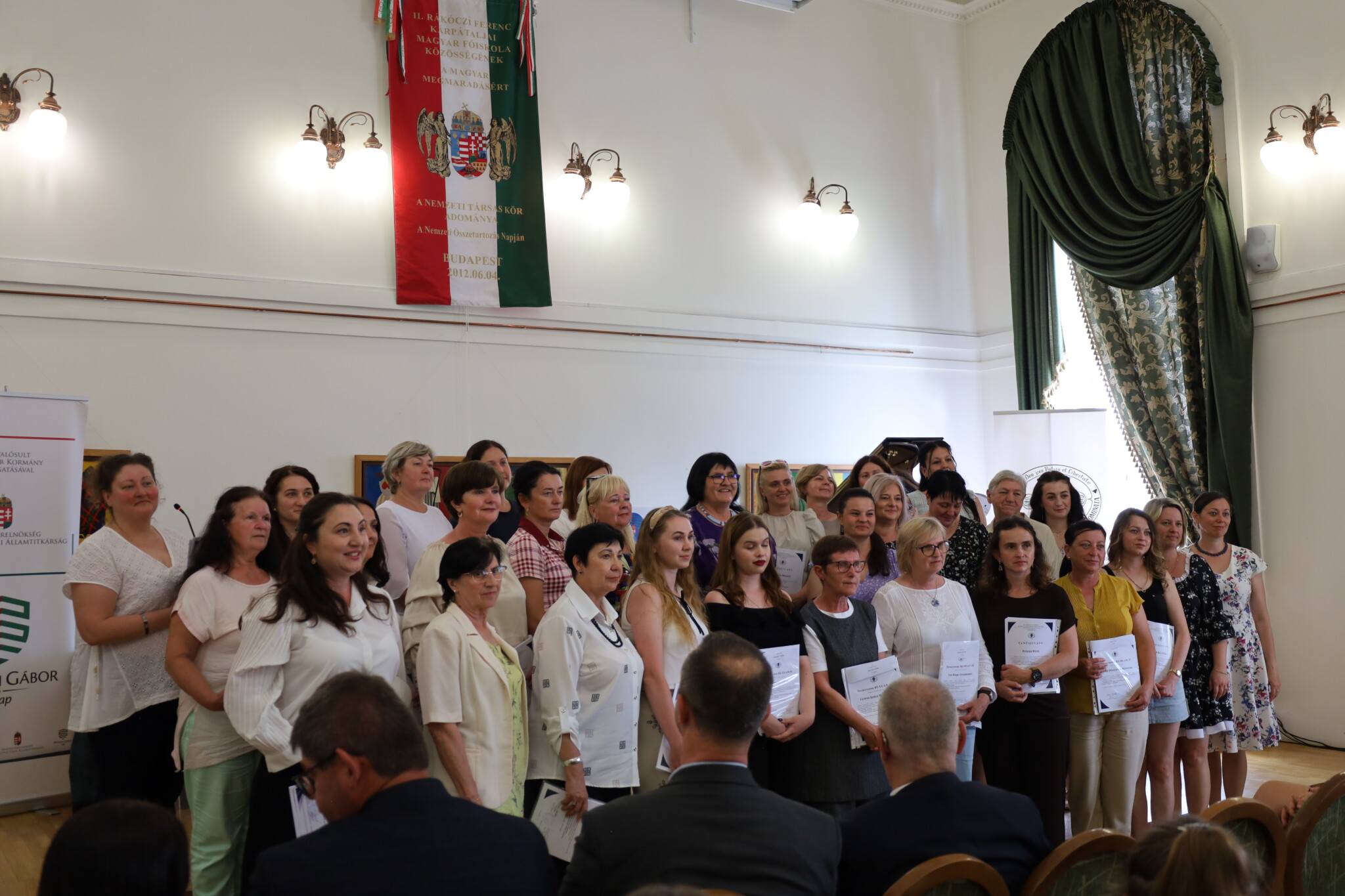
Organised by the Ferenc Rakoczi II Transcarpathian Hungarian University, the István Kótyuk language accessibility courses in Hungarian and Ukrainian took place between September 2025 and May 2026, with the support of the State Secretariat for National Policy of the Prime Minister’s Office and Bethlen Gábor Fund Management Ltd.
Between 12 August and 6 September 2026, 1,900 people registered for the language courses; of these, a total of 1,885 began the sessions for various reasons.
In the first half of the year, 60 teachers taught 1,173 people in 106 groups across 42 venues in 32 towns and villages on the Hungarian language course. On the Ukrainian language course, 26 teachers taught a total of 712 people in 65 groups across 14 venues in 8 towns and villages.
| Language | Number of participants | Number of instructors | Number of settlements | Number of locations | Number of groups
|
| Hungarian | 1173 | 60 | 32 | 42 | 106 |
| Ukrainian | 712 | 26 | 8 | 14 | 65 |
| Total | 1885 | (86) 83 | (40) 35 | (56) 52 | 171 |
Of the 83 teachers, 3 taught on both the Ukrainian and Hungarian courses. The project was implemented at a total of 52 locations, as Hungarian and Ukrainian groups studied at 4 locations, and in 35 settlements, as both languages were taught in 5 of them.
The initiative’s primary mission is to facilitate effective communication between the Hungarian- and Ukrainian-speaking populations in Transcarpathia, where the two languages and cultures have been closely intertwined for centuries and where linguistic diversity represents both an asset and a challenge. Smooth dialogue can reduce misunderstandings and tensions, whilst strengthening mutual respect, trust and a sense of community.
The 100-hour, practice-oriented curriculum developed by the methodologists (covering expressions and vocabulary necessary for everyday communication, as well as practical exercises) prepared the learners for the linguistic challenges of everyday situations. The teaching materials used during the training were prepared by Anikó Csurman-Puskás, Dr Adél Gál, Dr Katalin Hnatik and Dr habil. Natália Váradi, whilst those for the Ukrainian language training were prepared by Dr Andrea Molnár-Csatlós and Éva Panykó-Lénárt in the summer of 2025, ensuring a consistent standard and effectiveness of teaching.


The sessions were led by native-speaking and bilingual teachers. Their expertise was further enhanced by a training course held on 12–13 August 2025, led by Dr Katalin Pelcz, Head of the Hungarian Language Programme at the International Education Centre of the University of Pécs and co-author of the MagyarOK course books.
The official opening of the courses took place on 24 September 2025 at the Sándor Fodó Cultural Centre of the University of Rakoczi.
By 31 December 2025, 50 hours of teaching had been completed per group. During on-site visits, the language learners expressed their satisfaction with the teaching process, the learning environment and the instructors’ preparedness. Feedback from both the teachers and the participants was positive: the students actively participated in the lessons, the groups were well organised, and the teaching materials, worksheets and test papers prepared by the methodologists effectively supported the learning and teaching process.
From January 2026, the sessions took place according to the pre-determined and submitted timetable. The number of participants rose to 1,943. In 2026, nine children joined the Hungarian language course and seven the Ukrainian language course; these were players from the Rakoczi-GENIUS Handball Team. In addition to them, a further 42 people joined the Ukrainian language courses, thanks to the positive feedback received.
In the second term, 81 teachers continued their work. Following the end of the first term, after the death of Katalin Tanczár, her two groups were taken over by Irén Rádik as a combined group, whilst Erzsébet Orosz’s group in Nagybocskó was disbanded due to the war situation. Consequently, teaching took place in 169 groups during the second term. The number of venues fell from 52 to 51, and the number of localities from 35 to 34.
| Description | 1st term | 2nd term
|
| Number of instructors | 83 | 81 |
| Number of groups | 171 | 169 (104 Hungarian, 65 Ukrainian) |
| Number of participants | 1885 | 1943 |
| Number of locations | 52 | 51 |
| Number of settlements | 35 | 34 |
Consequently, the data changed as follows:
| No. | Settlement | No. of groups 1st sem. | No. of groups 2nd sem. | Language | Number of applicants | No. of students 1st sem. | No. of students 2nd sem. | Number of graduates
|
| 1. | Solotvyno | 2 | 2 | Hungarian | 16 | 16 | 17 | 17 |
| 2. | Nyzhnii Koropets | 1 | 1 | Hungarian | 9 | 9 | 9 | 7 |
| 3. | Rakoshyno | 1 | 1 | Hungarian | 13 | 13 | 13 | 9 |
| 4. | Berehove | 12 | 11 | Hungarian | 117 | 117 | 126 | 81 |
| 30 | 30 | Ukrainian | 384 | 374 | 361 | 341 | ||
| 5. | Bushtyno | 3 | 3 | Hungarian | 32 | 32 | 32 | 26 |
| 6. | Chop | 1 | 1 | Hungarian | 7 | 7 | 7 | 2 |
| 7. | Chepa | 2 | 2 | Hungarian | 23 | 23 | 23 | 17 |
| 8. | Fanchykovo | 3 | 3 | Hungarian | 47 | 47 | 55 | 55 |
| 9. | Kholmok | 1 | 1 | Hungarian | 13 | 13 | 13 | 7 |
| 10. | Khust | 2 | 2 | Hungarian | 26 | 26 | 26 | 14 |
| 11. | Korolevo | 1 | 1 | Hungarian | 11 | 11 | 11 | 8 |
| 12. | Mali Heivtsi | 1 | 1 | Hungarian | 8 | 8 | 8 | 7 |
| 4 | 4 | Ukrainian | 42 | 42 | 42 | 42 | ||
| 13. | Kontsovo | 1 | 1 | Hungarian | 5 | 5 | 5 | 3 |
| 14. | Yasinia | 5 | 5 | Hungarian | 35 | 35 | 37 | 37 |
| 15. | Matiiovo | 2 | 2 | Hungarian | 5 | 5 | 5 | 4 |
| 16. | Mynai | 2 | 2 | Hungarian | 26 | 26 | 26 | 17 |
| 17. | Mukachevo | 5 | 5 | Hungarian | 63 | 63 | 68 | 51 |
| 18. | Velykyy Bychkiv | 1 | 0 | Hungarian | 5 | 5 | 0 | 0 |
| 19. | Velyka Dobron | 9 | 9 | Ukrainian | 71 | 71 | 77 | 77 |
| 20. | Vynohradiv | 15 | 15 | Hungarian | 181 | 181 | 181 | 131 |
| 7 | 7 | Ukrainian | 65 | 65 | 68 | 65 | ||
| 21. | Radvanka | 2 | 2 | Hungarian | 47 | 47 | 47 | 9 |
| 22. | Rakhiv | 5 | 5 | Hungarian | 46 | 46 | 46 | 25 |
| 23. | Serednie | 2 | 2 | Hungarian | 19 | 19 | 20 | 20 |
| 24. | Svaliava | 2 | 2 | Hungarian | 21 | 21 | 21 | 11 |
| 25. | Teresva | 1 | 1 | Hungarian | 5 | 5 | 5 | 4 |
| 26. | Tiachiv | 12 | 12 | Hungarian | 158 | 158 | 158 | 133 |
| 27. | Tekovo | 4 | 4 | Hungarian | 42 | 42 | 43 | 43 |
| 28. | Dilove | 2 | 2 | Hungarian | 14 | 14 | 14 | 9 |
| 29. | Bobove | 3 | 3 | Ukrainian | 47 | 47 | 55 | 55 |
| 30. | Petrove | 6 | 6 | Ukrainian | 48 | 43 | 72 | 58 |
| 31. | Sasovo | 2 | 2 | Hungarian | 20 | 20 | 20 | 20 |
| 32. | Nove Selo | 1 | 1 | Hungarian | 12 | 12 | 12 | 8 |
| 33. | Vylok | 2 | 2 | Hungarian | 9 | 9 | 9 | 4 |
| 2 | 2 | Ukrainian | 41 | 41 | 44 | 34 | ||
| 34. | Uzhhorod | 11 | 11 | Hungarian | 107 | 107 | 107 | 85 |
| 35. | Vyshkovo | 1 | 1 | Hungarian | 25 | 25 | 25 | 13 |
| 2 | 2 | Ukrainian | 35 | 35 | 35 | 30 | ||
| Total | 169 | 1900 | 1885 | 1943 | 1579 |
In the first and second semesters, the Ukrainian language courses took place in 8 settlements, at 14 locations, in 65 groups with a total of 26 instructors; with 712 participants in the first semester and 761 in the second semester.
| No. | Settlement | Instructors per settlement | Location | Instructors per location | Instructor name
|
| 1. | Berehove | 13 | Ferenc Rakoczi II Transcarpathian Hungarian University | 9 | Tetyána Csonka, Natália Libák, Katalin Margitics, Andzselika Juricskó, Éva Molnár, Sándor Osztrovszkij, Éva Panykó-Lénárt, Okszána Pavlovics, Andrea Pősze |
| Ferenc Rakoczi II Transcarpathian Hungarian University’s Vocational High School | 2 | Szvetlána Beca, Ágnes Margitics | |||
| Transcarpathian Hungarian Lyceum (Berehove unit) | 3 | Szvetlána Beca, Irén Nemes, Irén Rádik | |||
| 2. | Mali Heivtsi | 1 | Transcarpathian Hungarian Lyceum (Mali Heivtsi unit) | 1 | Valéria Kiss |
| 3. | Velyka Dobron | 3 | Transcarpathian Hungarian Lyceum (Velyka Dobron unit) | 2 | Tetyána Komonyi, Viktória Kovács |
| Reformed Lyceum in Velyka Dobron | 1 | Andrea Molnár-Csatlós | |||
| 4. | Vynohradiv | 3 | Secondary School No. 3 in Vynohradiv (named after Zsigmond Perényi) | 3 | Ildikó Kampó, Viktória Kurta, Beatrix Vince |
| 5. | Bobove | 1 | Gymnasium in Bobove | 1 | Anikó Bábincu |
| 6. | Petrove | 1 | Egán Ede Vocational Training Center (Petrovo) | 1 | Edit Kiss |
| 7. | Vylok | 3 | Transcarpathian Hungarian Lyceum (Vylok unit) | 1 | Marianna Fenics |
| Secondary School No. 2 in Vylok | 3 | Álla Konrád, Marianna Fenics, Márta Kulcsár | |||
| 8. | Vyshkovo | 1 | Transcarpathian Hungarian Lyceum (Vyshkovo unit) | 1 | Miroszláva Roskó |
| Total | 26 | 26 |
Three colleagues also taught at two locations each: Szvetlána Beca, Marianna Fenics, and Miroszláva Roskó. In the second semester of the Hungarian language courses, 58 instructors developed the language skills of a total of 1,182 participants in 104 groups across 31 settlements and 41 locations. This is two instructors, two groups, one settlement, and one location fewer than in the first semester; however, the headcount increased by 9 people.
| No. | Settlement | Instructors per settlement | Venue | Instructor name
|
| 1. | Solotvyno | 2 | János Bolyai Lyceum in Solotvyno | Andrea Kacsmár, Adrienn Vajnági |
| 2. | Nyzhnii Koropets | 1 | P. Katalin Frangepán Grammar School’s Kindergarten in Nyzhnii Koropets | Krisztina Popovics |
| 3. | Rakoshyno | 1 | Gymnasium in Rakoshyno | Valéria Tar |
| 4. | Berehove | 4 | Ferenc Rakoczi II Transcarpathian Hungarian University | Anikó Csurmán-Puskás, Ilona Pápai, Irén Rádik, Vitalina Szabó |
| 5. | Bushtyno | 1 | St. Elizabeth Kindergarten in Bushtyno | Mária Takács |
| 6. | Chop | 1 | István Széchenyi Lyceum in Chop | Katalin Béres |
| 7. | Chepa | 2 | Tulipán Tanoda in Chepa | Natália Duda, Szabina Kocsis |
| 8. | Fanchykovo | 1 | Tulipán Tanoda in Fanchykovo | Zita Nagy |
| 9. | Kholmok | 1 | P. Katalin Frangepán Grammar School’s Kindergarten in Kholmok | Csilla Lesko |
| 10. | Khust | 1 | Secondary School No. 4 of Khust | Margaréta Körtvélyessy-Tehza |
| 11. | Korolevo | 1 | P. Katalin Frangepán Grammar School’s Kindergarten in Korolevo | Anikó Radvánszky |
| 12. | Mali Heivtsi | 1 | Greek Catholic Catechetical Classroom in Mali Heivtsi | Eleonóra Györke |
| 13. | Kontsovo | 1 | Lyceum of Kontsovo | Enikő Palkó |
| 14. | Yasinia | 4 | Secondary School No. 1 in Yasinia | Szilvia Darnyi, Mária Keszler, Mária Kolesznyikova, Ildikó Reparuk |
| 15. | Matiiovo | 1 | Tulipán Tanoda in Matiiovo | Gizella Zán |
| 16. | Mynai | 2 | P. Katalin Frangepán Grammar School’s Kindergarten in Mynai | Ádám Adrienn, Csilla Lesko |
| 17. | Mukachevo | 2 | Saint Stephen Lyceum in Mukachevo | Andrea Kozák, Alexandra Lengyel |
| 18. | Vynohradiv | 8 | Transcarpathian Hungarian Lyceum – Vynohradiv Educational Site | Ildikó Kampó, Rita Kosán, Beatrix Vince |
| Secondary School No. 3 named after Zsigmond Perényi in Vynohradiv | Gabriella Illés, Andzselika Kádár, Erika Kravcova, Jolán Palazsnik, Marianna Sztászjuk | |||
| 19. | Radvanka (part of Uzhhorod) | 1 | Saint Gerard Roman Catholic Parish, College for Advanced Studies | Mária Veresné Dikun |
| 20. | Rakhiv | 2 | Hungarian House in Rakhiv
Rakhiv Secondary Comprehensive School No. 1 (I-III degrees) Roman Catholic Community House in Tsiptseray Roman Catholic Parish in Rakhiv | Veronika Melnyicsuk, Ildikó Reparuk |
| 21. | Serednie | 1 | P. Katalin Frangepán Grammar School’s Kindergarten in Serednie | Mónika Mészár |
| 22. | Svaliava | 2 | Roman Catholic Church in Svaliava
Secondary School No. 1 in Svaliava | Marianna Kozár, Éva Popovics |
| 23. | Teresva | 1 | P. Katalin Frangepán Grammar School’s Elementary School and Kindergarten in Teresva | Julianna Cerkunik-Kvitka |
| 24. | Tiachiv | 9 | Hungarian-Language Lyceum named after Simon Hollósy in Tiachiv | Natália Csopik-Roskova, Gyöngyi Fényes, Gyöngyi Kristofóri, Erika Perebijnosz, Gabriella Sitka, Diana Taruszin |
| Hungarian-Language Reformed Lyceum in Tiachiv | Hajnalka Bodák, Gabriella Imszticsei, Mónika Kiss | |||
| 25. | Tekovo | 3 | Tulipán Tanoda in Tekovo
Reformed Parsonage in Tekovo | Oszkár Kócsi, Éva Evelin Czébely, Diána Lidka |
| 26. | Dilove | 2 | P. Katalin Frangepán Grammar School’s School and Kindergarten in Dilove
Roman Catholic Parish | Mihaela Dáncs, Mária Vadas |
| 27. | Sasovo | 1 | Kindergarten in Sasovo | Natália Duda |
| 28. | Nove Selo | 1 | Tulipán Tanoda in Nove Selo | Erzsébet Popovics |
| 29. | Vylok | 1 | Transcarpathian Hungarian Lyceum – Vylok Site | Gizella Zán |
| 30. | Uzhhorod | 5 | Office Building (Hojda Street)
Greek Catholic Caritas Reformed Parsonage in Uzhhorod | Dzsulietta Bem, Csilla Lesko, Enikő Palkó, Katalin Dikun, Mária Veresné Dikun |
| 31. | Vyshkovo | 1 | Transcarpathian Hungarian Lyceum – Vyshkovo Site | Judit Pál |
| Total | 65 |
Some teachers taught at multiple locations: Natália Duda (Csepei Tulipán School, Tiszaszászfalu Nursery), Csilla Lesko (Katalin Frangepán Grammar School, Minaj Nursery; Katalin Frangepán Grammar School, Homok Nursery; Office Building on Hojda Street, Uzhhorod), Enikő Palkó (Greek Catholic Caritas, Koncházai Lyceum), Ildikó Reparuk (Rahó Roman Catholic Parish, Cipszeráj Roman Catholic Community Centre), Mária Veresné Dikun (Uzhhorod Reformed Parish, St Gellért Roman Catholic Parish), and Gizella Zán (Transcarpathian Hungarian Lyceum – Tiszaújlak branch, Mátyfalva Tulipán School).
In Beregszász, Kisgejőc, Nagyszőlős, Tiszaújlak and Visken, lessons were held in both Hungarian and Ukrainian.
Where possible, children and adults were taught in separate groups.
Breakdown of groups by type
| No. | Language | Group type | 1st semester number of groups | 2nd semester number of groups | Total in 2nd semester
|
| 1. | Ukrainian | Child | 48 | 48 | 101 |
| Hungarian | 54 | 53 | |||
| 2. | Ukrainian | Adult | 14 | 14 | 58 |
| Hungarian | 45 | 44 | |||
| 3. | Ukrainian | Mixed (adult, child) | 3 | 3 | 10 |
| Hungarian | 7 | 7 | |||
| Total | 171 | 169 | 169 |
The proportion of children’s groups was exceptionally high, which clearly demonstrates the importance of starting language accessibility at an early age. In the case of the Hungarian language courses, 14 of the 53 children’s groups consisted of pre-schoolers.
The oldest participant in the Hungarian language course was 79, the youngest 6, whilst in the Ukrainian language courses the oldest participant was 59 and the youngest 7.
Based on the breakdown by group level, the vast majority of participants joined the training at beginner level, which supports the programme’s fundamental aim: to reduce communication barriers by ensuring the widespread acquisition of basic language skills. The presence of advanced-level participants, however, indicates that the training also offered opportunities for progression. In both the children’s and adult groups, there were opportunities to learn the language at A1, A2 and B1 levels.
Breakdown of groups by levels
| No. | Language | Group level | 1st semester | 2nd semester | Total in 2nd semester
|
| 1. | Ukrainian | A1 | 32 | 32 | 101 |
| Hungarian | 71 | 69 | |||
| 2. | Ukrainian | A2 | 16 | 16 | 38 |
| Hungarian | 22 | 22 | |||
| 3. | Ukrainian | B1 | 17 | 17 | 30 |
| Hungarian | 13 | 13 | |||
| Total | 171 | 169 | 169 |
Breakdown of children-adult groups by levels
| No. | Language | Group | A1 | A2 | B1 | Total
|
| 1. | Ukrainian | Child | 29 | 11 | 8 | |
| Hungarian | Child | 42 | 8 | 3 | ||
| 2. | Ukrainian | Adult | 0 | 5 | 9 | |
| Hungarian | Adult | 23 | 13 | 8 | ||
| 3. | Ukrainian | Mixed | 3 | 0 | 0 | |
| Hungarian | Mixed | 4 | 1 | 2 | ||
| Total | 101 | 38 | 30 | 169 |
In the Hungarian language course, there were two groups (one for adults and one for children) at A1 level in the first semester.
The documentation checks and accounting for the 50–50 hours per group were successfully completed in the second week of December 2025 and the second half of May 2026.
The requirements for the 100-hour course – module-end assignments, thematic tests, and oral and written exams – were met by 1,579 participants.
| Language | Beginner | Advanced | Total
|
| Hungarian | 637 | 240 | 877 |
| Ukrainian | 398 | 304 | 702 |
| Total | 1035 | 544 | 1579 |
As the language accessibility course drew to a close, participants were given the opportunity to sit a Hungarian language placement test on 11 April 2026. The exam was not compulsory, but it was made available to any student who wished to assess their level of proficiency and receive feedback on the knowledge they had acquired at the university’s international ECL Language Examination Centre.
The placement test consisted of a written and an oral section and was based on the comprehensive system of the international ECL language examination.
Online pre-registration for the placement test took place from 13 January to 28 February 2026. A total of 56 people registered, from 11 different locations, having been prepared by 19 tutors.
| No. | Settlements | Number of exam applicants | Number of successful examinees | Preparing teacher
|
| 1. | Berehove | 2 | 0 | Ilona Pápai |
| 6 | 3 | Irén Rádik | ||
| 1 | 0 | Vitalina Szabó | ||
| 2. | Chepa | 3 | 2 | Natália Duda |
| 3. | Fanchykovo | 2 | 0 | Zita Nagy |
| 4. | Korolevo | 1 | 1 | Anikó Radvánszky |
| 5. | Mynai | 1 | 0 | Csilla Lesko |
| 6. | Mukachevo | 8 | 8 | Andrea Kozák |
| 3 | 2 | Alexandra Lengyel | ||
| 7. | Vynohradiv | 7 | 3 | Ildikó Kampó |
| 1 | 0 | Jolán Palazsnik | ||
| 1 | 1 | Beatrix Vince | ||
| 8. | Svaliava | 1 | 0 | Éva Popovics |
| 9. | Tiachiv | 5 | 2 | Gabriella Imszticsei |
| 1 | 0 | Mónika Kiss | ||
| 3 | 0 | Gyöngyi Kristofóri | ||
| 10. | Uzhhorod | 4 | 2 | Dzsulietta Bem |
| 1 | 0 | Csilla Lesko | ||
| 1 | 0 | Enikő Palkó | ||
| 11. | Vyshkovo | 4 | 4 | Judit Pál |
| Total | 56 | 28 |
The assessment test material – both the written and oral sections – was prepared by the project’s methodologists. Candidates had 120 minutes to complete the tasks in the written test. Following this, the oral test took place simultaneously in four rooms. In each room, two candidates took the exam at the same time, or three in the case of an odd number of candidates. Before the exam began, candidates were required to present valid photo ID. The placement test proved to be an important milestone in the training process: it provided an opportunity for participants to gain an objective picture of their language development and to confirm their knowledge applicable to everyday communication.
Twenty-eight people successfully passed the placement test. The breakdown by language level was as follows: Level A1 – 4 people, Level A2 – 14 people, Level B1 – 10 people. The participants received their certificates at the certificate award ceremony on 5 June 2026.
On the same day, the course instructors also received Hungarian–Ukrainian certificates confirming completion of the training, which will be handed over to participants in the groups operating across the 34 localities in the coming days.
The István Kótyuk language accessibility courses were successfully implemented and fully achieved the set professional and community objectives.
Natália Váradi, programme coordinator,
Ferenc Rakoczi II Transcarpathian Hungarian University
