
Dear Guests,
Dear Colleagues,
Dear Students,
And especially, Dear First-Year Students!
We have gathered for the opening of the academic year.
A year ago, in this very place, I spoke about how we were facing a historic academic year. At that time, students had applied to a college, but they were able to commence their studies as university students.
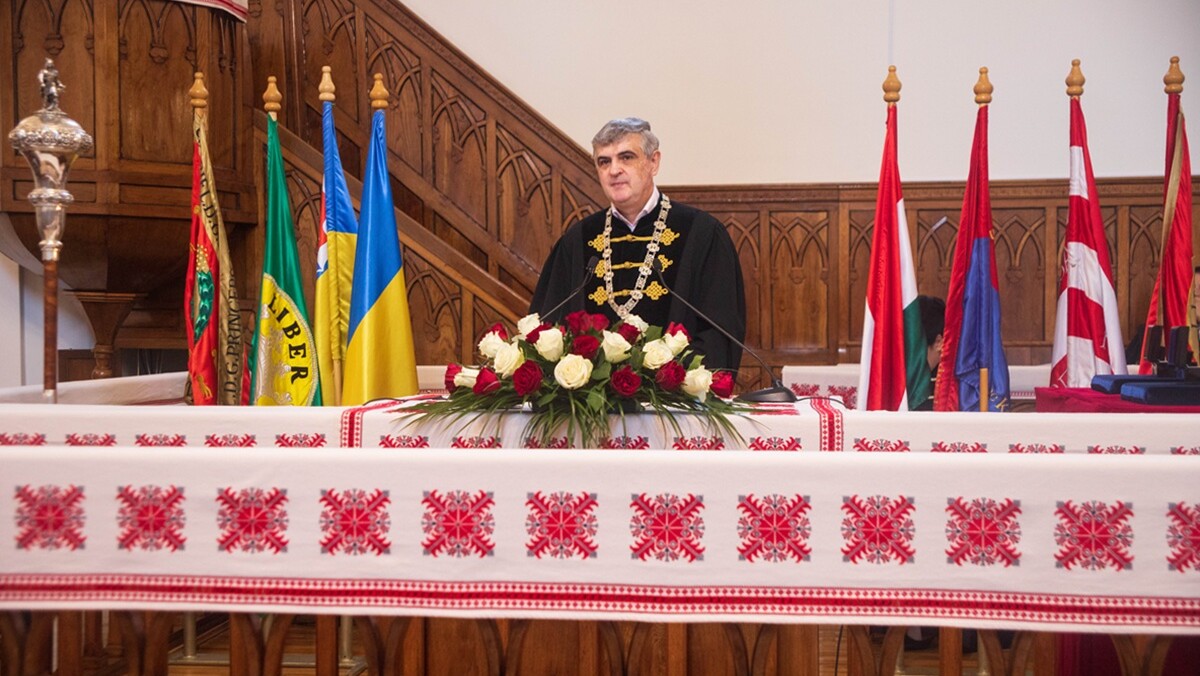
A year has passed since then. We have changed the nameplate, acquired the academic gowns, the rector’s and president’s chains of office, and the mace; thus, we now possess the outward symbols of a university.
We are also beginning to get used to the new name: now, only four times out of ten do I catch myself saying I am going to the college…
But perhaps it is not a bad thing if we do not get too accustomed to this university status.
Because the rank of a university is not a reward to be placed in a display case. It is an obligation. Today, we no longer need to prove that we have become a university. We must demonstrate, day by day, that we can hold our own as a university.
And there is perhaps no better occasion for this than the beginning of a new academic year.
Distinguished Assembly!
If one were to look only at the circumstances, they would not necessarily predict a bright future for a Hungarian university in Transcarpathia.
There is a war. The population is declining. Families have moved away. Young people have left the country. The energy supply is unpredictable. Legislation is constantly changing. And there are always those who, time and time again, explain to us why we have no future.
Numbers, however, are stubborn things.
In 2026, we received 1,468 applications for our bachelor’s degree programs. Out of these, 576 applicants enrolled at the University of Rakoczi.
For our master’s programs, we registered 238 applicants, and 117 new master’s students have commenced their studies with us.
This represents a total of 1,706 applications and 693 newly enrolled students.
Last year, in this very place, I proudly announced that we were starting the academic year with the highest enrollment in our history, 1,582 students.
Well, we have managed to break that record in just one year.
The 2026/2027 academic year began with 1,681 students at the University of Rakoczi. This means we have 99 more students this year than last year.
We have achieved all this at a time when sensible forecasts would rather predict a decline.
For me, this figure of 1,681 students is not merely a piece of statistical data.
It represents 1,681 decisions.
1,681 individuals who believed that it is worth studying. That it is worth obtaining a degree. That it is worth making plans. And that it is worth doing all of this right here, at the University of Rakoczi.
This is trust.
And trust is an honor, but a precarious thing: it must be lived up to.
Therefore, while we naturally rejoice at the record enrollment, we cannot assume that our work is done.
On the contrary. It is only just beginning.
During the past academic year, seven of our degree programs were evaluated by the Ukrainian accreditation agency, and we also submitted several of our programs for assessment within the Hungarian accreditation system.
We have an increasing number of colleagues holding academic degrees, and the number of our associate and full professors is steadily growing.
In the last academic year, our faculty members published 150 academic papers in journals indexed in the internationally recognized Scopus and Web of Science databases. These include studies published in the world’s leading scientific journals, ranked as D1 and Q1 according to scientometric evaluations.
All of this is important because a university is not a university simply because the word is written on its facade. It truly becomes a university when it not only imparts knowledge but also creates it.
Furthermore, the opportunities we can provide for our students are equally crucial.
Within the framework of our dual degree programs with the University of Miskolc and the University of Nyíregyháza, nearly 30 of our students have earned a Hungarian university degree alongside their University of Rakoczi diploma this year. This carries a particularly important message.
We do not want to force young people to choose between Transcarpathia and Europe.
We want to demonstrate that it is possible to go from Transcarpathia to Europe while still having a home to return to.
It is possible to participate in mobility programs, gain experience, see the world, and build networks—without having to turn one’s back permanently on the community from which they set out.
Dear First-Year Students!
You are now the newest citizens of this university.
Some of you certainly know exactly what you want to do with your lives.
Others probably less so.
Let me reassure you: this is completely normal.
One of the very purposes of a university is to ensure that in four or five years, you know a little more about the world than you do now—and ideally, about yourselves as well.
However, I ask you not to merely aim to obtain a degree.
Embrace the true university experience.
Attend your classes, for instance—it helps surprisingly much with exams.
Read. Ask questions. Debate with us. Participate in research, in student scholarly circles, in Erasmus and other mobility programs. Engage in sports. Go to the theater, to concerts, on excursions. Take part in the work of the Student Union.
Make friends, fall in love.
Because many years from now, you will most likely not remember the grade you received on a particular exam. But you will remember who you debated, laughed, traveled, and worked with. And you will look back on even the occasional heartbreak with bittersweet nostalgia.
A good university, you see, is not merely a service that one uses for a few years and then receives a piece of paper for.
A good university is a community.
And from now on, you are shaping this community, too.
Dear Colleagues!
The record student enrollment is a message for us as well.
1,681 individuals have entrusted a part of their future to us.
This is an immense responsibility.
Therefore, it is not enough for us either to simply hold our classes, fill out the exam sheets in IRIS, and check the boxes for accreditation procedures.
We must operate a university where there are high standards, but also humanity; where we preserve traditions, yet remain open to innovation; where there is authority, but no need for artificially erected walls between educators and students.
The saying is attributed to Gustav Mahler:
“Tradition is not the worship of ashes, but the passing on of the fire.”
I believe this is especially true for us.
Our institution—naturally including the periods of our legal predecessors, the Transcarpathian Hungarian Teacher Training College and the Ferenc Rakoczi II Transcarpathian Hungarian College of Higher Education—is celebrating the thirtieth anniversary of its founding this year.
Thirty years ago, we started with four degree programs and 74 students.
Today, we offer 34 programs and have 1,681 students.
Over these three decades, 3,062 individuals have received a total of 4,722 degrees from us. To grasp the magnitude of this number: the 2001 census still registered 156,000 Hungarians in Transcarpathia. For anyone familiar with our current demographic situation, I hardly need to explain what more than three thousand university graduates mean in the life of a community this size.
The students who graduated over these thirty years are now working in schools, businesses, public institutions, and research centers, both here at home and around the world. Many of them return to us, now as colleagues and partners, and many already have children studying here. For the history of a university is written not only by its buildings, its degrees, and its academic achievements, but also by the people who have studied here.
The most important achievement of these thirty years is not that we have grown larger and larger. It is that we have something to preserve, something to pass on, and, at the same time, the courage to change.
Because preserving tradition does not mean doing everything exactly as we did thirty years ago. If we did, we would probably still be sending messages to each other via fax. The tradition is alive when every generation adds something to it.
Distinguished Assembly!
A few weeks ago, in an interview, I was asked how it is possible to plan for the long term in Transcarpathia today.
My answer was: with difficulty. In times of war, there are no guaranteed scenarios. But there are goals.
We cannot wait for a time when all circumstances will eventually be ideal.
We cannot wait idly for the war to end, for the demographic situation to settle, for the energy supply to become stable, for legislation to become predictable, and for all our problems to disappear at once.
If we waited for all of this, life could easily pass us by in the meantime.
We must teach now.
We must research now.
We must build and run an institution now.
We must create opportunities now for the young people sitting here before us.
And perhaps this is why it is an especially beautiful thing to hold an academic year opening ceremony today.
Because every academic year that begins is a very simple statement: there is a future.
We do not know exactly what it will be like.
We do not know what difficulties it holds.
But we are preparing for it.
Dear Students!
I hope you will take full advantage of everything this university has to offer you.
Dear Colleagues!
I wish for us to have the strength, patience, and curiosity to remain worthy of our students’ trust in this academic year as well.
And for all of us, I wish that at the end of the 2026/2027 academic year, we can say not only that we made it through, but also that we moved forward.
And naturally, I continue to wish for us all what I have had to wish at far too many opening ceremonies by now: peace.
I wish you a successful, fruitful, and finally, a calm and peaceful academic year!
Vivat Academia!
Long live the University of Rakoczi!

