
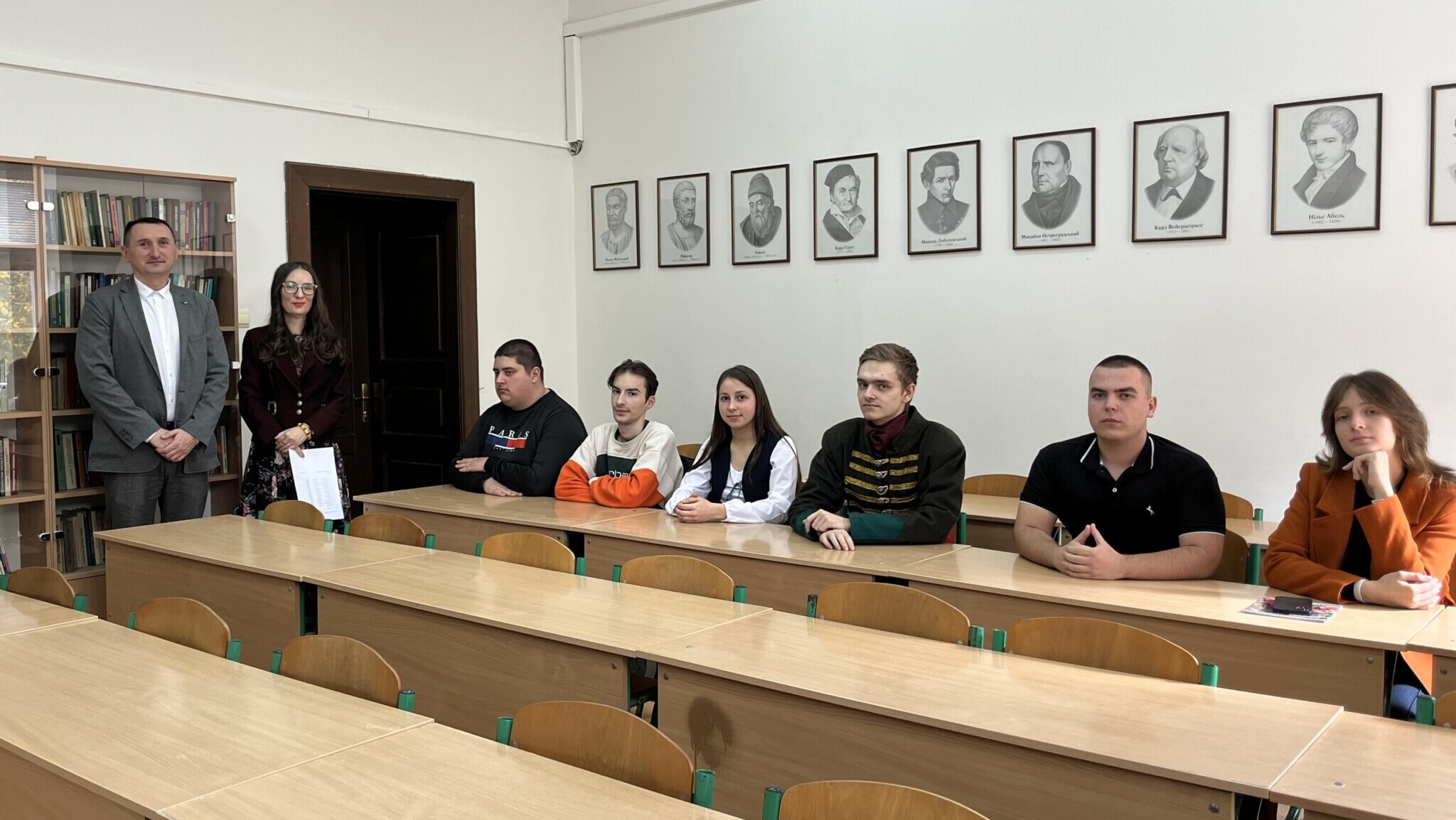
On October 30, 2026, a meeting of the student research club “ Mathematics and informatics as tools for developing students’ critical thinking ” was held at Ferenc Rákóczi II Transcarpathian Hungarian University. The event was attended by full-time bachelor’s degree students majoring in Mathematics and Informatics.
The aim of the meeting was to encourage students’ scientific interests, develop their research skills, and strengthen their logical, critical, and independent thinking. The event provided an opportunity for participants to discuss the role of mathematics and informatics in problem-solving and scientific inquiry.
The discussion focused on the characteristics of mathematical and computational thinking, the importance of analytical approaches, and various problem-solving strategies. Particular attention was paid to logical reasoning, critical evaluation of information, comparison of alternative solutions, and the importance of drawing independent conclusions.
During the meeting, participants also discussed additional opportunities for students’ academic and professional development. In particular, they explored opportunities to participate in student scientific conferences, prepare and deliver research presentations, and engage in academic and professional programmes offered by various specialized colleges (szakkollégiumok). Special emphasis was placed on the importance of student research activities, the selection of individual research topics, the presentation of research findings, and the acquisition of practical research experience.
The student research club meeting contributed to broadening participants’ academic knowledge, developing their scientific outlook, and deepening their interest in research activities. The event also highlighted that mathematics and informatics play an essential role not only in acquiring theoretical knowledge but also in developing critical thinking and independent problem-solving skills.
The activities of the student research club will continue to provide opportunities for students to develop their scientific potential, exchange academic and professional experience, improve their research skills, and actively participate in the academic community.

