
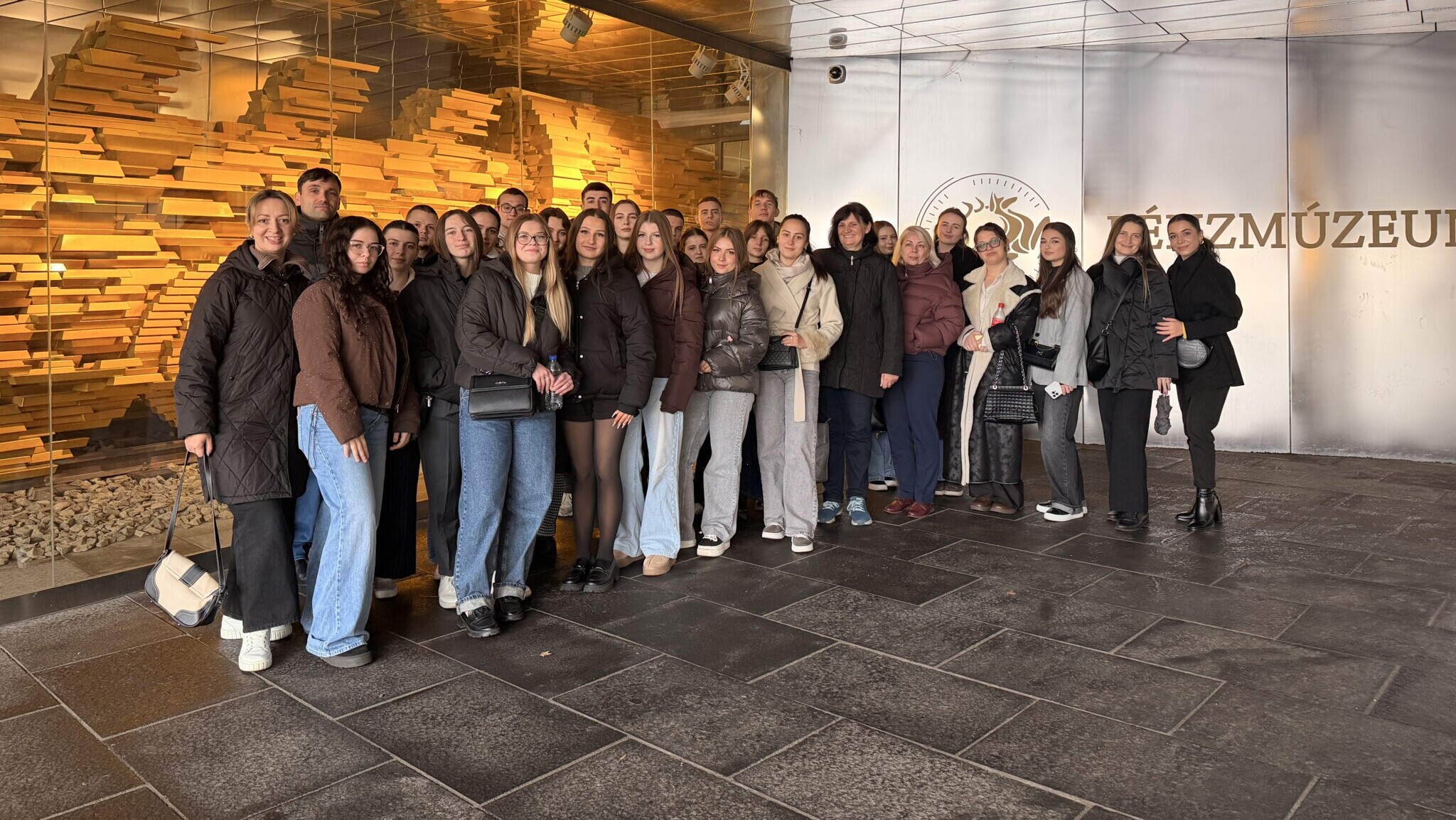
As part of the Makovecz Mobility Programme, second-year students from the Department of Accounting and Finance at Ferenc Rakoczi II Transcarpathian Hungarian University participated in a study visit to Budapest from 09 to 16 November 2026. Students specialising in Accounting and Taxation, as well as Finance, Banking, Insurance and Stock Markets, had the opportunity to broaden their knowledge through a range of professional, academic and cultural activities while gaining valuable experience and creating lasting memories together.
The primary objective of the study visit was to complement the theoretical knowledge acquired at university with practical experience, provide students with a deeper understanding of the economic and financial sectors, and introduce them to the activities of various academic and professional institutions. The diverse programme enabled participants to examine their existing knowledge from new perspectives and gain first-hand insight into its practical relevance and application.
The central event and principal professional highlight of the programme was a visit to Budapest Metropolitan University, where Master Lecturer László Juhász delivered a lecture entitled “Management Accounting from a Hotel Director’s Perspective”. The particular value of this event lay in enabling students to interpret the accounting and financial knowledge acquired during their university studies in a practical context, from a business management perspective. Exploring the viewpoint of a hotel director brought everyday business decisions closer to the students and highlighted the importance of applying theoretical knowledge in practice.


Through practical examples, the lecture illustrated the role of management accounting in business operations, with particular emphasis on how accounting and financial information support informed managerial decision-making. Students gained insight into how business data can inform managerial judgement, support planning and contribute to operational efficiency. This approach also drew attention to the economic processes and relationships underlying financial figures, emphasising the importance of analytical thinking and responsible management. The visit’s greatest professional value lay in connecting theoretical education with business practice. The lecture clearly demonstrated that, beyond organising data and reports, accounting is a fundamental tool for effective business management and strategic planning. The perspective presented broadened students’ professional horizons and helped them recognise the essential role of accounting knowledge in carrying out managerial responsibilities. The remaining activities complemented this central professional event, adding variety to the visit and enriching the participants’ shared experiences.
The next visit took place at the Research Institute for National Strategy, where participants gained insight into the institution’s activities and the interconnections between economic, social and national strategic issues. The professional presentations and institutional introduction encouraged students to consider their university studies within a broader context and recognise the links between different academic disciplines. The visit also highlighted the importance of understanding social and regional factors when analysing economic processes.
One of the highlights of the study visit was the Hungarian Academy of Sciences. Students had the opportunity to explore an exhibition commemorating the Academy’s 200th anniversary, which provided a comprehensive overview of its history, scientific heritage and significant contribution to the development of Hungarian science. The visit was complemented by professional lectures delivered by faculty members of the Department, combining an appreciation of academic traditions with the opportunity to deepen contemporary professional knowledge.
A particularly engaging and academically relevant experience was the visit to the Money Museum. During the guided tour, students learned about the origins of money, its historical development, its various forms and its role in economic life. Interactive exhibitions and informative presentations enabled participants to view the financial concepts studied at university from a fresh perspective. The visit reinforced the importance of historical knowledge and practical examples in developing a more comprehensive understanding of economic relationships and financial processes.
Participants also visited MOL Campus, where they were introduced to the characteristics of a modern international corporate environment. The visit provided insight into contemporary workplaces, where economic, financial and technological expertise are becoming increasingly interconnected. A particularly memorable experience was the visit to the SkyDeck observation deck, which offered breathtaking panoramic views of Budapest. Beyond discovering the city from a different perspective, this experience also strengthened the sense of belonging and solidarity within the student community through shared impressions and experiences.
Another important professional destination was the Museum of Finance Guard and Taxation History, where the group was welcomed by Anikó Dvorszky, a specialist in the field. During a guided tour accompanied by a professional presentation, students gained a comprehensive understanding of the history of financial law enforcement and taxation, the emergence and development of tax systems, and their socio-economic significance. The programme proved particularly valuable for students of both specialisations, as its subject matter was directly related to their academic studies. The historical overview helped participants understand that contemporary financial and taxation systems are the result of long-term developmental processes and that their operation is shaped by the economic and social conditions of each historical period.
However, the four-day programme offered considerably more than the opportunity to expand professional knowledge. Joint sightseeing activities, cultural programmes and informal discussions created valuable opportunities to strengthen personal relationships, encourage mutual understanding and reinforce a sense of community. Students not only discovered new institutions and professional fields but also had the opportunity to get to know one another better outside their familiar university environment.
One of the greatest strengths of the Makovecz Mobility Programme lies in its ability to bring together knowledge acquisition, the exchange of experience and community building. Study visits of this kind encourage young people to become more open to new ideas and perspectives, expand their professional networks and recognise that lifelong learning and cooperation are essential foundations for continuous professional development.
Throughout the visit to Budapest, different aspects of accounting, finance, taxation, economics and corporate operations were brought together in a meaningful and interconnected way. Students experienced how the knowledge acquired at university can be applied across a wide range of professional contexts. They also recognised that, alongside a strong theoretical foundation, practical experience, broad professional awareness and effective interpersonal skills are indispensable for building a successful career.
The Department of Accounting and Finance considers it a priority to provide students with high-quality theoretical education while creating extensive opportunities for practical learning, professional networking and broadening their academic and personal horizons. The study visit to Budapest represented another valuable step towards achieving these objectives.
We would like to express our sincere gratitude to everyone who contributed to the success of the study visit through their insightful lectures, engaging professional programmes and warm hospitality.
The knowledge gained, the experiences shared and the memories created during these four days will remain a lasting source of inspiration and value for our students, supporting them throughout their university studies and future professional careers.
Department of Accounting and Finance

