
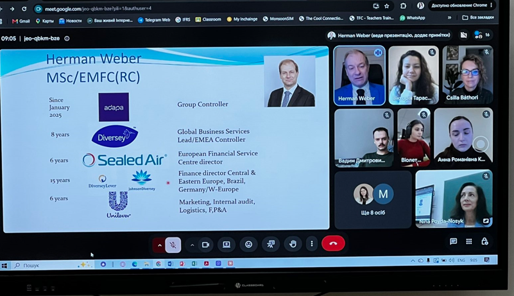
On 18 November 2026, the Department of Accounting and Finance of Ferenc Rakoczi II Transcarpathian Hungarian University held an open guest lecture titled “Resilience on Country and Company Level”. The lecture was organised at the invitation of Prof. Nina Poyda-Nosyk and delivered by Herman Weber, Group Controller of the international packaging company adapa Group (Austria). The event’s special guest was Chilla Bathori, an expert in change management, corporate communications and finance process transformation in international companies.
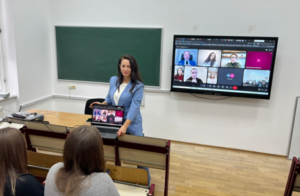
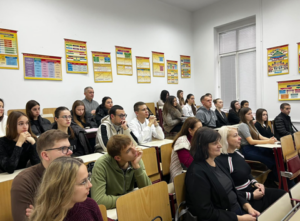
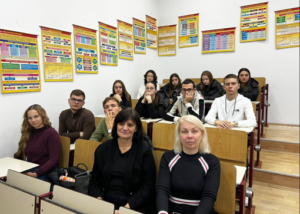
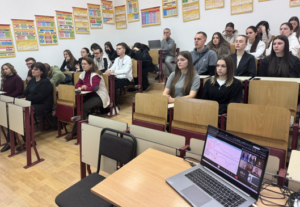
The event was held in English in a hybrid format, in room 226 and online. From Rakoczi University, the participants included 2nd-year students of the “Financial Protection” and “Accounting and Taxation” educational programmes, 3rd- and 4th-year students of the “Financial Security” educational programme, and 1st-year master’s students of the “International Accounting and Taxation” educational programme. Guests of the lecture were 3rd- and 4th-year students of the “Finance and Credit” educational programme at Uzhhorod University, led by Viktoriia Minkovych, Senior Lecturer at the Department of Finance and Banking. Faculty members of the Department of Accounting and Finance also took part (Prof. Viktoriia Makarovych and Senior Lecturers Oksana Perchi and Gabor Potoki), as did colleagues from other departments of Rakoczi University (Assoc. Prof. Marta Fabian).

Mr. Herman Weber has more than 20 years of senior management experience in financial management and controlling at the multinational corporations Unilever, JohnsonDiversey, Sealed Air and Diversey. He has headed finance functions in Hungary and Central and Eastern Europe, Brazil, and Germany and Western Europe. He has also managed global and regional finance operations with shared service centres in the United Kingdom, Romania, India and Mexico.
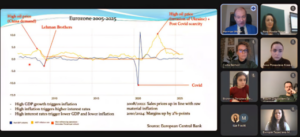
In his lecture, the speaker showed how the resilience of countries and companies is tested by real crises. Using European Central Bank data on the eurozone economy for 2005-2025, he traced the major shocks of the past two decades: the oil price surge driven by Chinese demand, the collapse of Lehman Brothers, the COVID-19 pandemic, and the rise in energy prices following the full-scale escalation of the war in Ukraine, combined with post-COVID shortages. Mr. Herman Weber explained the cyclical logic of the economy: rapid GDP growth fuels inflation, inflation forces central banks to raise interest rates, and high interest rates in turn slow down both growth and inflation. Drawing on the companies he has worked for, he showed how businesses respond to these processes. In 2008 and 2022, sales prices were raised in line with rising raw material costs, and between 2010 and 2024 margins increased by 2 percentage points.
The speaker also examined the case of Brazil. After hyperinflation was brought under control in 1994, currency controls kept inflation low, but the economy stagnated. The lifting of currency controls in 1999 led to a 50% devaluation, after which the economy began to grow again with moderate inflation. For the company, this devaluation became an opportunity to raise prices, restore eroded margins and increase local supply.
To conclude, Herman Weber shared important practical lessons for businesses and for students planning a career in business. He closed with two quotations: “The secret of success is to do the common things uncommonly well” (John D. Rockefeller) and “Never waste a good crisis!”
At the end of the lecture, students Mariana Kobryn, Ivanka Holubka, Veniamin Shvets and Oleksandr Molnar asked the speaker about cash flow management during a recession, the experience of multinational corporations, the factors behind the resilience of Ukrainian companies, and the balance between cost-cutting and investing in the future.
Chilla Bathori spoke about her participation in the World Finance Forum in Brussels, where she moderated a panel discussion on how finance leaders are rethinking the skills, structure and capabilities of their teams for the next decade. She emphasised the importance of responsible and mindful use of artificial intelligence, the development of critical thinking, and ways to build new skills in the context of digitalisation.
Meetings like this with practitioners give students a rare opportunity to see how theoretical knowledge of finance, accounting and controlling is applied in real business on an international scale.
The Department of Accounting and Finance sincerely thanks Mr. Herman Weber for his insightful lecture and Ms. Chilla Bathori for the time she devoted to our students, and looks forward to further fruitful cooperation!
Department of Accounting and Finance

