
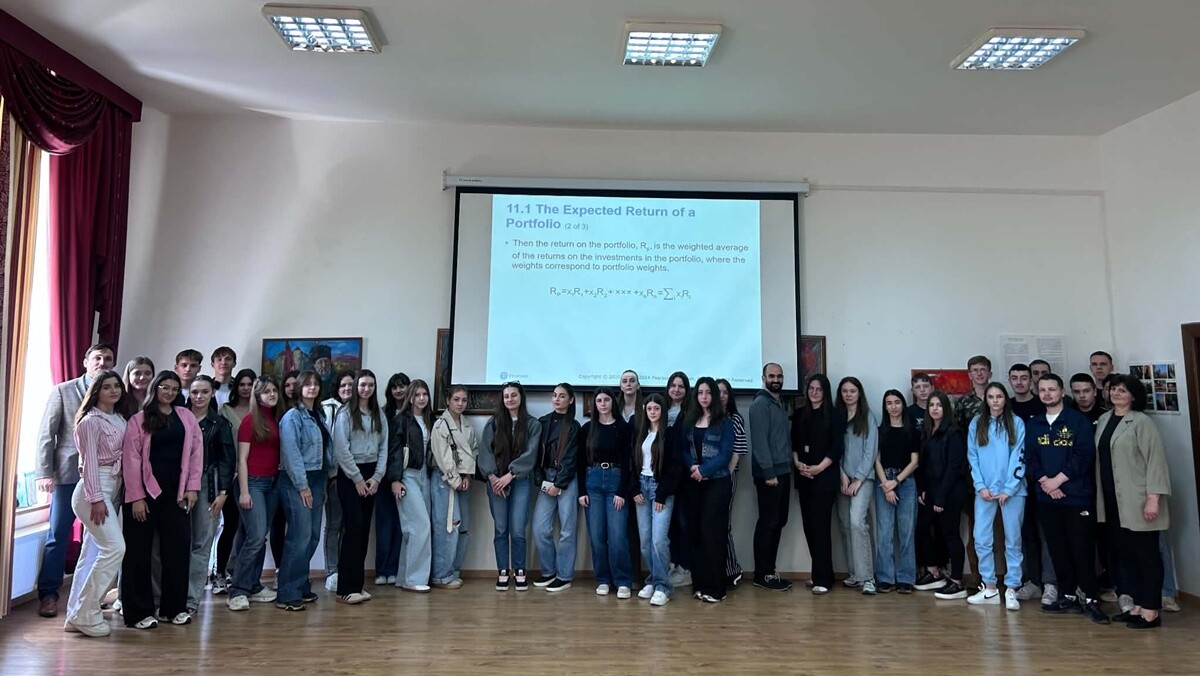
During April and May 2026, within the framework of the international academic cooperation of the Department of Accounting and Auditing, a series of lectures was delivered by Botond Géza Kálmán, Associate Professor at Neumann János University, as part of the International Finance course. The lectures focused on key aspects of business value creation, financial logic, and the development of practical financial reasoning.
One of the lectures explored value creation through different business models, including production, service provision, and holding financial assets. Students analyzed well-known international companies such as Netflix, BMW, Visa, PayPal, and Amazon, examining how these companies generate and capture value through the production of goods or the provision of services. Special emphasis was placed on the concept of mutual value creation: businesses create added value for consumers, while profit serves as an incentive for growth and expansion. From the perspective of international finance, this is closely linked to global value chains, pricing mechanisms, and maintaining sustainable profitability in international markets.


On another lecture day, the focus shifted to debit and credit logic, balance sheet structures, and practical financial operations. Using the example of credit card usage, students analyzed:
- the relationship between cash inflows and outflows;
- the difference between cash flow and profit;
- the impact of interest costs and financial discipline;
- the role of financial incentives, particularly cashback systems.
This approach enabled students to connect everyday financial decisions with accounting logic and the principles of liquidity management and cost of capital, both at the household and corporate levels.
During a subsequent lecture, an important question was raised: how does the process of value creation transform into measurable financial performance, and how do financial decisions—particularly the use of credit—affect long-term wealth and profitability? This question connected the micro-level of financial behaviour with the macro-level of international financial systems, highlighting the importance of financial discipline in ensuring sustainable economic development.
The lectures were interactive and student-centred in nature. Students:
- presented international companies and identified their business models;
- applied accounting logic to real-life financial operations;
- analyzed the impact of credit card usage and the timely repayment of liabilities;
- distinguished between revenue, expenses, costs, and profit.
The lecturer highlighted the students’ active participation, openness to professional discussion, and their ability to connect theoretical concepts with practical financial examples. According to him, working with the students was highly productive, and their level of engagement contributed to a deeper understanding of financial processes.
The lecture series served as an excellent example of effectively integrating the theoretical foundations of international finance with applied financial reasoning, which is an essential component in the professional preparation of future specialists in the field of finance and economics.

