
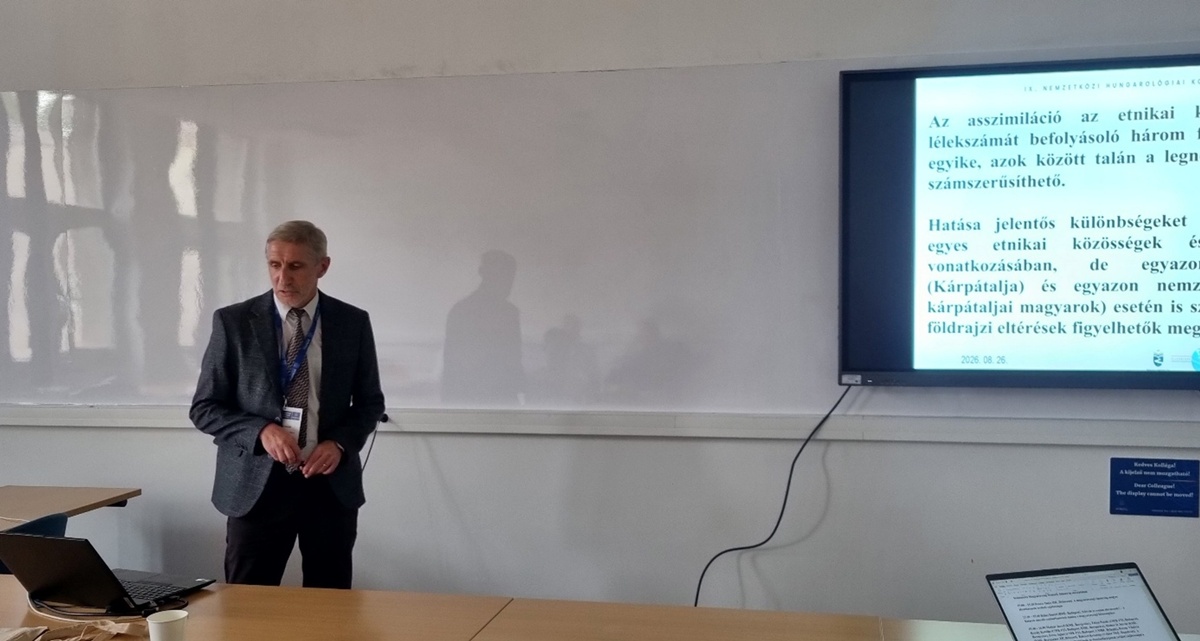
From 24 to 29 August 2026, the University of Miskolc hosted the 9th International Congress of Hungarian Studies. At this prestigious academic event, the Department of Geography and Tourism of Ferenc Rákóczi II Transcarpathian Hungarian University was represented by Dr Yosyp Molnar, Head of the Department, and Dr Stefan Molnar D, Associate Professor of the Department.
On 26 August, our lecturers took part in the geographical symposium entitled “Geographical Aspects of Hungarian National and Local Studies”. The symposium, organised by Károly Kocsis, focused on the spatial characteristics of Hungarian national self-awareness and identity, as well as the social and demographic processes taking place in the Carpathian Basin.
A presentation entitled “Territorial Characteristics of the Assimilation and Dissimulation of Hungarians in Transcarpathia in the 21st Century” was delivered by Yosyp Molnar, Patrik Tátrai, Katalin Kovály, Stefan Molnar D, Ágnes Erőss, Viktória Ferenc and Krisztián Rákóczi as co-authors. The study examined how processes of assimilation and dissimilation affect the size and spatial structure of the Hungarian community in Transcarpathia. Particular attention was paid to intergenerational changes in identity within mixed families and to the decisive role of local ethnic proportions.
The next presentation at the symposium was delivered by Stefan Molnar D under the title “Changing Geographical Patterns of Hungarian Interest Representation in Transcarpathia”. In his presentation, he reviewed the spatial characteristics of the political, local governmental, institutional, educational, cultural and civil representation of the interests of the Hungarian community in Transcarpathia from the period following the political transition to the present day. Using thematic maps, he presented the traditional centres of interest representation, areas where their importance has weakened, and emerging new local centres. Special attention was also given to the effects of administrative reforms, changes in electoral districts, emigration and war-related mobility.
Participation in the congress provided an opportunity to present the human-geographical research conducted at University of Rákóczi in an international academic environment, to discuss new scientific findings, and to strengthen cooperation between research centres in Hungary and Hungarian research communities beyond its borders.

