
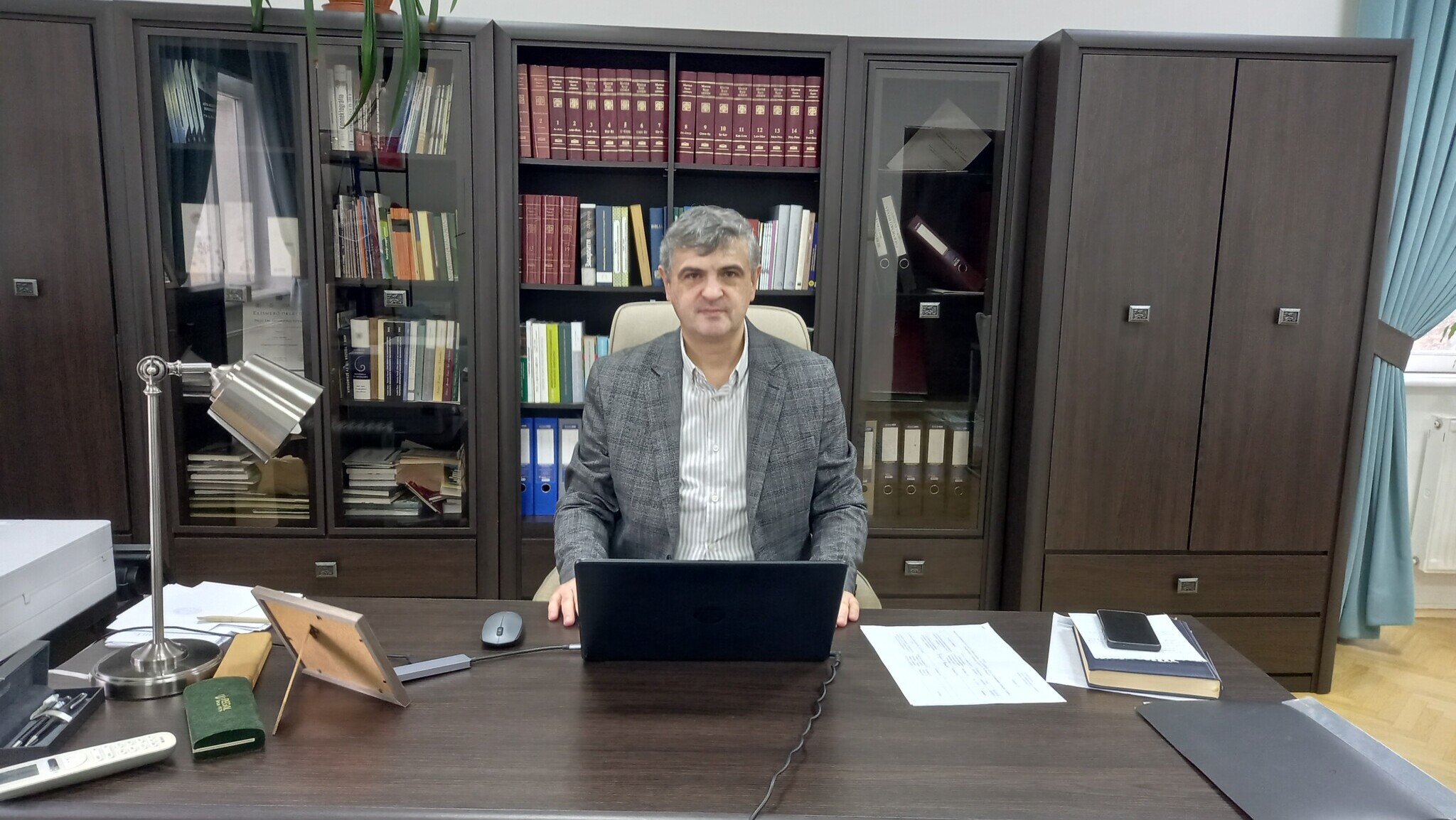
While dictionary publishers around the world single out the distortions of the online sphere, the inferior by-products of artificial intelligence, or the provocations of social media as the defining concepts of the year, in Ukraine very different words come to the fore. Words that describe not trends, but destinies. Words behind which lie human lives, fears, and forced decisions. This is the environment in which a higher education institution must also hold its ground—continue to operate, develop, and preserve its community.
For the Ferenc Rakoczi II Transcarpathian Hungarian University, 2025 was simultaneously a year of survival and progress: the institution transitioned from a college to a university, while amid the challenges of everyday life under wartime conditions it had to ensure the continuity of education. In our year-end conversation, Rector István Csernicskó speaks not only about figures and achievements, but also about what it means to be a university at a time when mere operation is itself an achievement.
WORD OF THE YEAR
– According to the Cambridge Dictionary, the word of the year in 2025 was parasocial, referring to a one-sided relationship someone feels toward a celebrity, a fictional character, or even AI. The Macquarie Dictionary chose the term AI slop as its word of the year, which can be rendered in Hungarian as MI-moslék and is used to describe low-quality online content generated by artificial intelligence. Oxford University Press, meanwhile, selected ragebait as the word of the year—online content deliberately designed to provoke anger or outrage through its frustrating, provocative, or offensive nature. For you personally, what was the word of the year in 2025?
– I hadn’t really thought about it. Off the top of my head, I can’t say what the word of the year was or will be in Ukraine this year, but if I remember correctly, last year it was бусифікація—that is, busification. This term is essentially synonymous with manhunting: it refers to violent, forced mobilization carried out with complete disregard for human rights and human dignity. In the volume Politics and War: Patterns and Paradoxes of Linguistic Development (2022–2023), published in 2024, I also read that in the year the total war broke out, one of the most controversial neologisms in Ukraine was могілізація. This word was created through a creative fusion of mobilization (мобілізація), meaning military conscription, and grave (могила). Much like busification, the expression reflects universal and compulsory—often violently enforced—military mobilization, while also alluding to the fact that, in a total war, mobilization not infrequently leads to the grave. In this sense, mobilization very often becomes “mohilization.” The volume points out that могілізація was listed in the Ukrainian neologism dictionary Myslovo as one of the most important words of 2022. Since a word of the year is typically a characteristic neologism—a newly coined term—and since changes in vocabulary follow social, political, economic, or cultural shifts, it becomes clear that Anglo-Saxon dictionary editors are, in a sense, fortunate: they do not have to live in a state engaged in an endless war, partly even against its own citizens. For them, the challenge is the online world. For us, survival itself is what is at stake.
– Could “university” itself be the word of the year for the Rector of the higher education institution in Berehove?
– It certainly points to the fact that one of the most significant events for our institution in 2025 was our transition from a college to a university. Naturally, we regard this as a success, but I wouldn’t say that it overshadowed everything else. For me personally, the event of the year was that we once again launched new degree programs, meaning that we have never before offered such a wide range of programs to young people as we did this year. Obviously connected to this, we were able to admit a large number of first-year students, and our total student enrollment reached a record high. It is also a great source of satisfaction for me that we can provide opportunities for professional advancement and development for our teaching staff, which is evidenced by the fact that more and more of them are earning associate professorships and even full professorships, including colleagues who only a few years ago obtained their higher education degrees here with us. For me, this means that despite the extremely difficult circumstances of war, we have been able to expand and develop, and to remain a stable point of reference in Berehove and in Transcarpathia.
16 HOURS OF DARKNESS
– And yet, you must certainly be facing serious difficulties as well.
– Everyone has difficulties, unfortunately. It is far from easy to ensure the smooth operation of an institution of this size when, for example, according to today’s power-outage schedule, electricity supply in the zone where most of our buildings are located is interrupted intermittently between 4:00 and 7:00 a.m., then again from 12:00 to 2:00 p.m., and finally from 7:00 to 9:30 p.m., as part of ongoing rolling blackouts. In other words, we are facing 16 and a half hours without electricity versus only 7 and a half hours with power—a ratio of roughly two-thirds darkness to one-third light. And yet, we continue to function: teaching goes on, and there is heating and electricity in the dormitories. How much effort this requires from my colleagues is something only they truly know, because they simply do not have the time to talk about it.
– Still, the fact that you have moved from being a college to becoming a university must surely be an indicator of the work carried out over the past years—or am I mistaken?
– Becoming a university was an important milestone, but above all a symbolic one. What truly matters is the work itself. Our colleagues indeed made serious efforts to achieve this goal. The unveiling of the new nameplate on the façade of our main building on Berehove’s central square was a fine and perhaps visually striking ceremony, but the work done behind the scenes is not visible from afar. Few people know, for example, that in the 2025 calendar year alone, nearly 120 internal regulations were adopted at our institution concerning the organization of education. These regulations deal either with day-to-day operations or with the development of our internal quality assurance system, and this figure does not even include regulations related to student affairs or staff matters, the combined total of which also exceeds one hundred. During this calendar year, we drafted and adopted around 20 new internal policies, and revised, amended, and modernized a further 25–30. Meanwhile, the institution’s principal decision-making body, the Senate (Academic Council), adopted approximately 200 resolutions over the course of the year. All of this together is necessary in order to meet the expectations placed on a modern, outward-looking, and continuously developing higher education institution.
– Is there a single figure, achievement, or event that you would definitely like to highlight among the results of 2025?
– If I really have to choose just one, I would point to a piece of data I received recently from the head of our Career Tracking Office, who monitors the professional paths and life trajectories of our graduates. According to our records, in the 2025–2026 academic year a total of 665 of our former graduates are working in 150 Hungarian-language (or partially Hungarian-language) educational institutions operating in Transcarpathia. These include kindergartens and schools, and of course our own university as well. When I hear so-called “experts” say day after day that almost all Hungarians have fled Transcarpathia, I always think of these colleagues—and, naturally, of the children and young people they are teaching.
THE THIRD MISSION
– While preparing for this interview, I looked into the institution’s five-year development strategy and came across the term “third mission.” What does that mean?
– Successful and modern universities, in addition to their educational and research responsibilities—which constitute the first and second missions—also carry out what is known as third-mission activities. Within this framework, they take on tasks in areas such as culture, sports, and local economic and enterprise development, thereby actively shaping and influencing their own economic and social environment. No university operates in a vacuum; it cannot remain isolated. Our responsibility is to participate in shaping the environment around us. I believe our presence in the cultural life of the immediate region is quite noticeable. To name just a few examples, the Pro Cultura Subcarpathica civil organization, founded by our institution, and the Tulipán Tanoda network are widely recognized. In sports, our role is currently less prominent, but for instance, the county futsal championship organized by our university—now for the fifth consecutive year—has undoubtedly become a high-quality and popular event. And once our sports pool and the associated sports complex are completed, we will be able to take our sporting activities to an even higher level.
– What about the economy? You mentioned that this is also part of the so-called third mission.
– As part of our economic stimulation activities, we recently assessed the direct and indirect impact of our institution and its affiliated entities on the economy of Berehove, the surrounding micro-region, the district, and Transcarpathia as a whole. It turned out that through job creation, human resource development, taxation that shapes the budget, and businesses serving our staff and students, we play a significant role in boosting the local economy. Our university and affiliated institutions also contribute substantially through real estate development, investments, and activities aimed at protecting built heritage. Here, it may be enough to mention how much the main building of our university and the Kölcsey Ferenc Specialized College define the atmosphere of Berehove’s central square. Similarly, the renovation of the Perényi Mansion in Beregardó or the refurbishment and re-commissioning of the former Secondary School No. 2 in Berehove created jobs, generated tax revenue, and contributed to a more orderly and aesthetically pleasing environment. These investments clearly benefit not only our institution, but the entire city of Berehove and, indeed, all of Transcarpathia. This, however, only reflects our direct impact. If we also consider, for example, small enterprises such as Kiscsikó or Ham-lett—which were originally established solely to provide meals and services for our staff and students—today, in addition to serving hundreds of university members daily for lunch, coffee, and snacks, they also provide services to the general public through walk-in customers and deliveries across the city.
PLANS FOR THE FUTURE
– We’ve covered a lot in this year-end conversation; now let’s turn to plans for the future. What can we expect from the University of Rakoczi in 2026?
– Planning for the future in Transcarpathia today inevitably takes a conditional form. In times of war, there are no guaranteed scenarios, only goals to which we cling whenever possible. The plans for the University of Rakoczi in 2026 are of this nature: new programs, completed investments, successful accreditations, and a functioning, thriving community. However, this is not institution-building for its own sake. In a region where uncertainty is a daily experience, our university represents stability, predictability, and a vision for the future—not only for students and faculty, but for Berehove and the entire region. Perhaps the most important lesson of the year is this: while the world is noisy with online distractions, what truly matters here is having institutions that quietly and consistently do their work, even when the light may be less than the darkness.
-hai-

